



02 Apr 2025 Staying future-ready with VML’s annual top 100 trends
VML Intelligence’s “The Future 100: 2025” is here – an always fascinating and truly fabulous annual guide to the coming year and beyond, featuring 100 game-changing trends across 10 different sectors, including food and drink…
This unparalleled report examines key trends across 14 different countries and features interviews with top industry experts and more.
2025 will be a year of paradoxes, where advanced technology meets digital disconnection, where the dawn of the trillionaire collides with cost-cutting and the prolonged challenges of the “cost-of-living”, and where brands must find that delicate balance between resonance with restraint.
In addition, it’s time to prepare for new realities — by our own imaginations and by technology that conjures next-level imagined worlds for us to live in. As people are faced with unsettling issues, they are proactively creating a reality that makes sense to them — one that is imaginative and optimistic.
This is a time when cocktails levitate, technology can help us transcend the constraints of the body, and anything we imagine can be realized. 2025 is the year of possibilities.
Here are but four trends from the report related to FMCG foodbev…

TREND: CHAOS PACKAGING
Brands are using packaging to play with audiences’ expectations.
Gravy in a beer can. Tampons in an ice cream tub. Coffee in a tube. “Chaos packaging” is leaping onto shelves in stores — and helping challenger brands cut through in a crowded market.
The term first emerged on X in April 2024 when Michael J Miraflor, an advisor and consultant, posted some visual examples with the caption:“I’m calling this trend ‘Chaos Packaging’ until someone comes up with something better.”
The name stuck and so has the approach, with brands throwing out accepted designs from their categories and mixing it up.
UK cooking sauce company Potts’ Partnership was an early adopter. In 2019 it started using cans for its stocks and sauces, mimicking some of the design cues of craft beer. The result is a product that feels fresher and more dynamic than the incumbents it shares a shelf with, with better recyclability than a plastic pouch or glass jar. The strategy is clearly working, as the brand announced plans in 2024 to launch in international markets.
Chaos packaging is a formula that works in myriad category combinations. Electrolyte cordial Oshun, launched in 2024, comes in a pump bottle similar to that of an up-market moisturiser.
And Graza olive oil launched its beer can-style packaging in spring 2024, featuring vivid green colours and thick lined illustrated cartoon figures.
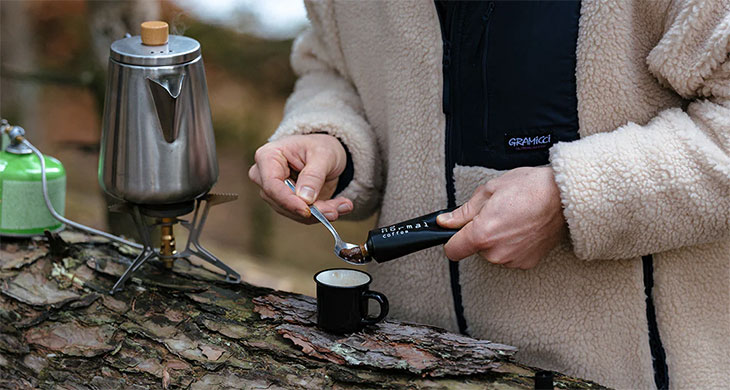
Nature lovers will be familiar with the joys of a fresh coffee in the open air — and the annoyance of bringing the necessary components with you. Employing chaos packaging for a functional purpose, No Normal is a dissolvable coffee paste, packaged in a toothpaste-style tube. Simply squeeze into your favourite camping mug, add water, and your caffeine hit is ready
Tampon company Here We Flo packages its products in biodegradable ice cream tubs. Aside from its playfulness, the concept contains an in-joke from co-founder Tara Chandra, who craves ice cream during her period.
Why it’s interesting: A raft of challenger brands are coming to the fore, and they’re trying to find cost-effective and playful ways to knock incumbents off their perch — such as spring water brand Liquid Death, which comes in a can.
Entrepreneurs know they can’t outspend bigger companies, so they must out-manoeuvre them instead.

TREND: IMAGINED WORLDS
Abstract, fantastical flavours are reinvigorating food and drink brands with a sense of transportive wonder.
From Oreo’s limited-edition Space Dunk cookie, stuffed with a layer of blue and pink “cosmic crème,” to CosMc’s French Toast Galaxy Latte, new for fall 2024, food and drink brands are challenging our palates with products that promise the taste of space and beyond—transporting us to imagined worlds in the process.
Syrup maker Torani has recognised the current appetite for fantastical flavours, naming its Puremade Galaxy Syrup as its 2024 flavour of the year.
“We’re leaning in to the fantastical creation of worlds and creating a level of escapism,” Beth Stallings, director of innovation and communication at Jeni’s Splendid Ice Creams in the US, tells VML Intelligence.
Describing the launch of the brand’s Punk Stargonaut collection, which re-imagines a fictional journey into space, she says: “Jeni’s pulls inspiration from anywhere — even a Matisse painting — because when it comes to desserts, you’re looking to feel a certain way. Gen Z and gen alpha are actively seeking out the strange, surprising, and unique.”
In 2025, Rasmus Munk of Copenhagen’s Alchemist restaurant will team up with SpaceVIP for Space Perspective voyages, offering a six-hour dining experience at $495,000 per ticket.
In Dubai, Zenon restaurant combines mythical flavours with AI entertainment for a “culinary adventure like no other.”
Bubble tea shops continue to expand outside China with ever more complex flavours and unexpected brand tie-ups, and the global bubble tea market was valued at $2.46-billion in 2023, according to Fortune Business Insights.
With over 4,000 stores across 300 cities around the globe, behemoth HeyTea heralded its UK launch with a collaboration with the English Royal Ballet and Opera.
It included a limited-edition three-layer tea — with chocolate cheese foam, brown sugar boba, and red blossom milk tea — demonstrating that fantasy flavours aren’t just about taste but also offer an immersive, imaginative escape, allowing people to indulge in something whimsical, nostalgic, or entirely new.
Why it’s interesting: Playful, humourous, and mood-enhancing fantasy flavours for food and drink are a form of accessible, quotidian escapism, and talking points that can be shared with family and friends.

TREND: INSTANT HEALTH COCKTAILS
Cocktails are being reinvented through a wellness lens for the health-focused and sober-curious.
Prompted by consumer yearning for more wellness-oriented options, a new generation of cocktails is emerging, promising the uplift and conviviality of alcohol without the negative impacts on body and mind.
The “Sober Curious Generations” report by NCSolutions found that 61% of gen Z Americans planned to drink less in 2024, while Mintel reported that 71% of gen Z and 73% of millennials are interested in trying a sober curious lifestyle as it “aligns with priorities like health and wellness.”
Holistic health practitioner Dr Giulietta Octavio is a leading proponent in this space. Her Ceybon AF range of adaptogenic, nootropic, alcohol-free, mushroom-infused aperitifs claim to boost drinkers’ moods while mimicking the feeling of drinking alcohol.
Octavio told FoodDive that Ceybon uses a range of botanicals to mirror the viscosity and bitterness of drinking alcohol, while the drinks “ultimately shift someone’s mood.”
Australian brand Via’s sparkling alcohol-free cocktails use its patented Viagenics adaptogens to “balance your cortisol levels, banish brain fog, and improve focus and mental capacity.”
The range uses the language of alcohol, offering margarita, brut, and aperitif options, which cofounder and CEO Sarah Morley says was a very intentional move to make it “feel like a natural, seamless choice rather than a deviation from the norm.”
“Today’s consumers are more intentional about their wellness and lifestyle choices,” she tells VML Intelligence. “Via drinks allow people to savour the ritual of a celebratory drink, but with a twist that actually promotes wellbeing. It’s about making a choice that feels luxurious, flavourful, and fun — while still supporting self-care and connection.”
Why it’s interesting: “Consumers are looking for more than just a replacement to alcohol; they want something that supports their lifestyle and values,” says Morley.
Food and beverage brands must reinvent the tactile and mood boosting rituals of traditional consumption habits for a new era of wellness-focused consumers

TREND: OZEMPIC WORLD
The global appetite for weight-loss drugs is driving disruption across industries.
GLP-1 weight-loss drugs such as Ozempic are the catalyst for a pronounced shift in consumer preferences and needs across a wide range of categories. According to venture capital firm PeakBridge, the market for the drugs grew by 300% between 2020 to 2023 in the US, where one in eight consumers are said to have used them.
This correlates with VML data which finds 12% of global consumers say they have done so. Generative AI-powered consumer data platform Tastewise reveals that social media discussion about GLP-1 skyrocketed by 1,054%. And the trajectory is still upward, with patents on both Ozempic and Wegovy due to expire in China as early as 2026.
Roots Analysis suggests the global market will expand at a CAGR of 11.1% until 2035. With the drug suppressing users’ desire to eat by 20-30%, according to Morgan Stanley research, it is reshaping consumers’ relationship with food. John Furner, executive director of Walmart in the US, said, “we see a slight retraction in the overall basket. Fewer units, a little less calories,” as GLP-1 users embrace protein-rich, low-carb options, and home-made meals.
Morgan Stanley also reports that nearly two-thirds of GLP-1 users are spending less on restaurants and takeaways. Alcohol, too, is reportedly less appealing to users. Nestlé has responded to these emerging needs with the launch of its Vital Pursuit meal range, which offers nutritional support to GLP-1 patients, while CostCo has launched a specialised health care service for weight loss.
Vital Pursuit by Nestlé Physical changes due to the rapid weight loss associated with drugs like Ozempic will also drive opportunity in beauty and aesthetics. Skincare and treatments focused on skin elasticity, firming, and plumping are likely to see rising interest as users seek to combat so-called “Ozempic face,” which refers to hollowed-out appearance and skin laxity. Haircare too stands to benefit, tackling loss in hair density related to weight loss.
As for the body, the Guardian reports that gyms and fitness centers are already putting more emphasis on free weights and machines as people are losing muscle mass, not just fat, on GLP-1 drugs, and seeking to maintain muscle.
Retail intelligence platform Edited reveals that dress options that are a US 14 and above have decreased by 15% year-on-year. In tandem, Vogue Business highlights a move away from inclusivity by brands on the S/S25 runways, suggesting the pendulum may be swinging backward on an already fragile size inclusivity movement.
Why it’s interesting: GLP-1s are disrupting lifestyles and reframing the conversation about weight management. In the Ozempic era, brands will find new opportunities to cater to emerging need states, but will also need to navigate the ethics of equitable access, the evolving conversation around body image, and the long-term health impacts of these drugs.