


31 Jan 2025 FoodDive’s key foodbev trends to watch in 2025
FoodDive.com is a go-to resource for excellent foodbev news and insights, focusing on the US market. Its editors have put together their six key trends that they expect to play a more prominent role this year.…
After navigating food inflation and then “shrinkflation,” a pandemic, and changing beverage preferences, CPGs are expected to respond to consumers’ needs with nutrient-dense products and creative beverages.
Food manufacturers will navigate a diverse set of consumer needs in 2025 and what seems like a massive reset in how the industry develops and packages snacks as well as better-for-you and novel ingredients. All of this, with the spectre of possible tariffs from the new presidential administration affecting the ingredients sector, 2025 promises to be intriguing for the food industry.
What was once a snack, is now considered a meal. What was once a beverage is now considered medicine or, at the least, a health boost. With these major changes in what consumers want and expect, interesting innovations from food manufacturers are in store.
Here’s a look at six food trends that Food Dive editors and industry experts predict for 2025. From the massive influence GLP-1 users will have on innovation and products, trending aquatic ingredients, and novel beverages to benefit stacking and the always evolving use of AI for production and product formulation.
GLP-1 is not just a phase
“It’s causing a tsunami for the food industry,” said Gary Stibel, founder and CEO of the New England Consulting Group.
The new wave of GLP-1 drugs has food companies researching to fulfill the needs of this new consumer base. Protein, fibre, less sugar as well as convenience are top priority for this group.
Goldman Sachs says the number of GLP-1 users could be as much as 15 million people, or 13% of the US population, by 2030. But that number may be misleading since many consumers also are finding the drugs online or in compound forms not prescribed by doctors and thus, not tracked.
The diabetes and weight-loss drugs suppress appetite, but there is evidence the medications affect what tastes good to people and even what and how they drink…..READ MORE HERE!
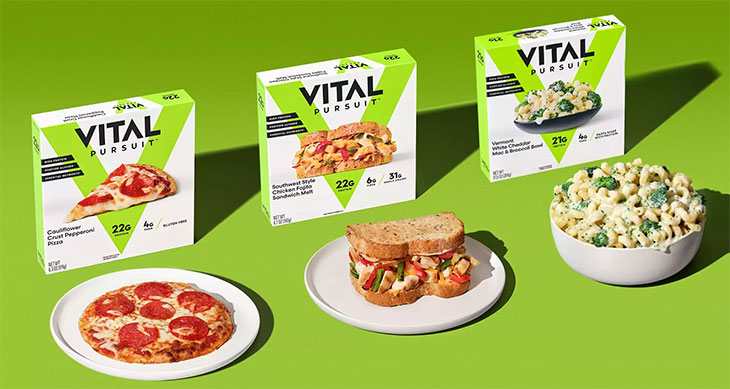
[The featured pic above is Nestlé Vital Pursuit frozen, single-serve product line, its first major US brand launch in nearly three decades as the food giant looks to meet the needs of consumers taking GLP-1 medications and other individuals focusing on weight management.]
AI meets the big-time
As artificial intelligence matures, the once futuristic technology is set to become a bigger part of operations at food and beverage companies in 2025.
“Three years ago, there was some interest, but now, when we talk to food and beverage organizations, everyone is interested,” said Mikael Bengtsson, industry and solution strategy director of food and beverage at Infor.
AI is morphing from being used to crunch large volumes of data to identifying trends, such as consumer buying patterns, into one that can help food and beverage companies in more creative ways. These so-called generative AI uses include writing product descriptions, developing a recipe that incorporates that food item or assisting in designing the packaging.
Bengtsson said that while it’s still “pretty early” for companies to use AI this way, it will increasingly become a bigger part of how they do business.
The food and beverage sector “is not an easy business to be in, and with all its challenges that means that efficiency is more important than ever,” Bengtsson said. “The future winners are not the ones who are dodging” AI at their business.
Nearly every company is deploying AI in some way…..READ MORE HERE!
CPGs light up portfolios with limited-time offerings
From Oreo’s kooky collaboration with Coca-Cola on co-branded sodas and cookies to Kellanova’s Apple Jack’s Pop-Tart’s, brands in the food and beverage landscape are competing to capture consumers’ shortening attention spans by shaking up their product lines with unique and noteworthy product launches.
In order to induce a sense of scarcity, many brands are using limited-time offerings (LTOs) for novel products, often in collaboration with another brand. While often these products combine the likeness and flavours of several brands under the same company’s portfolio, there are also items that bring together the properties of two or more businesses within the industry.
LTOs are a vital part of any merchandising strategy in order to get people talking, according to Dr. Russell Zwanka, professor of food marketing at Western Michigan University.
“Customers are a lot of fun and love to try new things. An LTO gives a customer a compelling reason to buy something and gives them a deadline,” Zwanka said…. READ MORE HERE!
Benefit stacking stacks up
Consumers in 2025 are placing more value on food products that contain or “stack” multiple benefits important to them — and product manufacturers are taking notice.
The number of eating behaviours — such as clean label, fibre, gut health, low sugar, sustainability or protein — that the average consumer is involved in has increased to 7.2 in 2024, up from 6.5 a year earlier, according to a study by Ardent Mills, a supplier of ingredients to many of the largest food manufacturers.
Stacking is even more pronounced among younger consumers aged 18-34 where the number of eating interests tops eight.
Before, consumers would “approach food in a sort of one-dimensional approach” by focusing just on a product that is gluten-free or organic, said Matt Schueller, director of insights and analytics for marketing at Ardent Mills. “Now, they’re literally stacking [multiple] priorities” into a single product.
When companies develop a food product, they typically center it around an enduring trend, such as whole grains, protein or immunity. Then, with the help of companies like Ardent Mills, manufacturers look for other attributes they can add, or stack, such as ingredients that are organic or can be sustainably traced.
Stacking can be lucrative with consumers willing to pay more for benefits that matter to them. When a product has several attributes consumers care about, price becomes less of a concern while the perceived value increases…. READ MORE HERE!
Beverages break category boundaries
As people look for more value out of what they drink, the days of clearly defined beverage categories have gone flat.
Brands are adapting to the changing demands with new product lines that serve several purposes at the same time — with energy drinks, cocktails, coffee and soda increasingly overlapping.
A growing number of consumers are moderating their drinking habits or abstaining from alcohol altogether. Seltzer brands like White Claw are leaning into the growing trend of nonalcoholic cocktails as consumers seek adult drinks that eschew booze. One of the decade’s biggest success stories, water brand Liquid Death, is finding success at bars as a booze-free sparkling option.
At the same time, soda makers are shaking up their formulas to infuse more purported health benefits. Many consumers are turning increasingly to brands like Olipop, Poppi and Health-Ade’s SunSip that include prebiotics and probiotics targeting the gut microbiome. But the efficacy of these brands’ claims have been called into question by some critics.
Meanwhile, giants in the soda category are relying more heavily on unique flavour launches and alcoholic beverages — like Coca-Cola’s collaboration with Jack Daniels and Sprite’s Absolut cocktails….READ MORE HERE!
Looking to the sea for ingredients
Plant-based aquatic ingredients are expected to be a major food trend in 2025, as consumers continue to seek more sustainable protein sources. Think sea moss, duckweed, kelp and seaweed.
The ingredients are gaining attention for their sustainability and nutritional value. Sea moss, in particular, has become a popular wellness ingredient due to its high levels of iron, magnesium, and iodine.
Sea moss is being incorporated into everything from beverages to gummies, and even bacon alternatives, such as MaryRuth’s Sea Moss Gummies and Umaro Foods bacon. Other brands are using aquatic ingredients to replicate the taste of seafood, further connecting plant-based aquatic ingredients to the burgeoning alternative seafood market.
For functional ingredients, agar-agar is becoming popular…..READ MORE HERE!
Source: FoodDive.com