



30 Jan 2023 Fake meat was supposed to save the world. It became just another fizzling fad…
Beyond Meat and Impossible Foods wanted to upend the world’s $1-trillion meat industry. But plant-based meat is turning out to be a flop. Here is the Bloomberg article that has generated a great deal of heat….
Ever since founding Beyond Meat in 2009 with the then fantastical idea of making meat without animals, Ethan Brown has been giving the equivalent of one extremely long TED Talk.
In 2013 he took the stage at the Wired Business conference, explaining that the world had a very real greenhouse gas-emitting meat problem and that venture capitalists could make a bigger impact investing in fake meat than in solar energy. At Toronto’s annual Ideacity gathering three years later, he said his goal was to replicate the “blueprint of meat“.
By the time he appeared at Goldman Sachs Group’s Builders & Innovators Summit 2019, he explained that his mission demanded the urgency and scale the US mustered for World War II and that his products would simultaneously help solve heart disease, diabetes, cancer, climate change, natural resource depletion and animal welfare.
Just like technology had rendered the horse-drawn carriage obsolete, he told the crowd at the New York Times’ climate conference this past fall, so, too, would his system of breaking down plants transform the protein at the centre of the plate. “This,” he said, “is something that I feel is inevitable.”
Silicon Valley didn’t need much convincing that a better veggie burger could become the next world-changing disruption.
Whereas the quinoa-and-bean patties of yore were for the crunchy set, Brown’s beef facsimile, concocted in a lab to look and taste like the real thing, meant the vast majority of meat eaters could give up their burgers without having to give up anything at all.
Along with the venture capitalists came investors from every corner of culture — Leonardo DiCaprio, the Humane Society of the United States and former McDonald’ CEO Don Thompson.
Even Tyson Foods, the biggest maker of real meat in the US, invested and then invested again, catapulting the young El Segundo, California-based startup to a $1.3-billion valuation by 2018.
Bill Gates wanted in, too, backing not one but two companies with veggie burgers that “bleed” like real beef — Beyond, as well as its rival Impossible Foods.
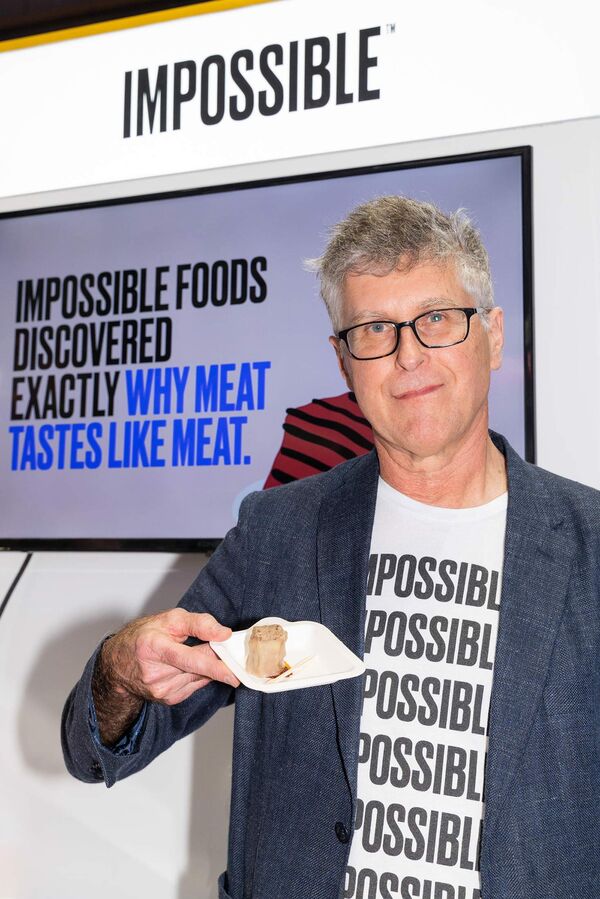
Brown had licensed someone else’s process, but Impossible was the brainchild of a Stanford University biochemist named Pat Brown (no relation to Ethan). When Pat founded Impossible in 2011, his big breakthrough was realising that a molecule called heme was the key to meat’s meatiness. He made heme with genetically modified yeast and patented the use of what the company called its magic ingredient: soy leghemoglobin.
Before Impossible had sold even a single burger, the company managed to raise $183-million. Pat also worked the circuit, including an actual TED Talk (technically, it was TEDMed) in 2015.
Speaking in slightly more apocalyptic terms than Ethan, Pat referred to the “ongoing wildlife holocaust” caused by the world’s insatiable demand for meat, while an assistant sizzled an Impossible Burger onstage beside him.
“I know it sounds insane to replace a deeply entrenched, trillion-dollar-a-year global industry,” he said, “but it has to be done.” Four years later, when the New Yorker profiled Impossible, Pat predicted his company would “take a double-digit portion of the beef market” by 2024 before sending it into a “death spiral.”
Next he would target “the pork industry and the chicken industry and say, ‘You’re next!’ and they’ll go bankrupt even faster.”
But Big Meat is still alive and well. After Beyond went public in 2019 — at the time the most successful major initial public offering since the 2008 financial crisis — competitors rushed into the space, followed by a category-wide pandemic surge. Since then the industry has plunged.
Supermarket sales of refrigerated plant-based meat plummeted 14% by volume for the 52 weeks ended Dec 4, according to retail data company IRI. Orders of plant-based burgers at restaurants and other food-service outlets for the 12 months ended in November were down 9% from three years earlier, according to market researcher NPD Group.
Beyond lost sales in almost every channel last quarter. Over the past year it laid off more than 20% of its workforce, lost more than half of its C-suite and halted projects including vegan hot dogs and the next alt-protein frontier of cell-cultured meat, according to people with knowledge of the matter, who asked not to be named discussing private information about the company.
None of the biggest fast-food chains that had announced partnerships with Beyond — KFC, Pizza Hut and, most important, McDonald’s — have put a single permanent item on their US menus.
While an index of packaged-food companies on the S&P 500 was up about 4% from a year ago, as of Jan. 17, Beyond’s stock price is now hovering around $16, down about 76% from a year earlier and roughly 93% from its peak in the summer of 2019.
Impossible, meanwhile, is faring better — but Pat is out at the company. Last April he stepped down to chief visionary officer, replaced as CEO by a Chobani executive, before taking a leave of absence.
Under new CEO Peter McGuinness, Impossible has spun up new products such as animal-shaped faux chicken nuggets and blitzed supermarkets, leading to more than 50% retail sales growth in the US in 2022. While it has added restaurant partners, some of its long-standing ones are finding consumer excitement has either hit a wall or is declining.
Shares of Impossible, a private company, are currently trading at around $12, says Prab Rattan, head of capital markets at Hiive, a marketplace for private stock trading. That’s about half the price during its last fundraising round, based on PitchBook data.
Plant-based meat’s most reliable enthusiasts at this point are those original veggie burger stans, vegans and vegetarians. The all-important meat eaters do partake, but at a much lower frequency. “They’re just not that into it,” says Chris DuBois, head of IRI’s protein practice.
How did an industry with so much riding on it — backed by so much money — suddenly fizzle out?
The companies declined to make Ethan Brown and Pat Brown available to talk to Bloomberg Businessweek, but at that New York Times climate conference in October, Ethan pointed his finger at the actual meat industry for fake meat’s headwinds.
“They are doing their very best today to suggest that our process is somehow unhealthy or that our products are full of chemicals,” he said. “These things are not true.”
Whatever critiques the meat industry is lobbing are the same ones plenty of consumers are figuring out for themselves. Like fat-free Snackwell’s cookies or Lay’s olestra-laden WOW Chips — or any other glut-without-the-guilt food trend that periodically cycles in and out of the zeitgeist — the incremental benefits are eventually offset by concerns over what else might be in there.
Many meat eaters initially excited by fake meat, who didn’t mind the not-quite-there taste or texture, eventually took a closer look at the ingredient list and couldn’t figure out whether they were actually trading up. Were they eating these burgers to curb carbon emissions or lower their blood pressure? Was it a healthier alternative or a sodium-filled, overprocessed substitute?
Plant meat still costs more than the real thing, and with inflation pushing up prices across the supermarket, many grocery shoppers have swapped the expensive imitation for chicken or, in some cases, beans and lentils.
Meatless meat, it turns out, seems less a world-changing innovation than another food trend whose novelty is wearing thin
“Before we were seeing this incredible growth rate. But when you lose that momentum, you lose your certainty around how big plant-based meats can be,” says Thomas George, portfolio manager at investment research company Grizzle, who in 2019 predicted plant-based meat could overtake 10% of the meat industry in 10 years if it could match meat’s prices. “The opportunity for this category,” he says now, “is more murky. Nobody should be under the illusion that these are health foods”
Before Beyond Meat unveiled the Beyond Burger, there was the Beast. When Ethan introduced the frozen patty in 2015, the company called it a “protein shake on a bun.” Although he ended up ditching it, the Beast’s health claims, such as high levels of protein and zero gluten or soy, remained front and center on Beyond Burger’s packaging. (Whenever asked, Pat defended the health cred of Impossible’s product against beef, though he preferred to talk about replacing animal agriculture by 2035.)
But nothing preached the virtues of plant-based eating to the masses like The Game Changers, a James Cameron-produced documentary that hit Netflix in 2019.
The Game Changers followed world-class vegan athletes, with cameos by doctors, scientists and even Arnold Schwarzenegger, who, before he became mostly vegan, once told Sylvester Stallone that he “hit like a vegetarian.”
Veganism, according to the film, would make a person not only healthier but also stronger, with better endurance and even longer, harder erections.
Ethan added the film to his arsenal. “If you look at movies like Game Changers, etc,” he told Bloomberg Television in 2019, “you can affect even individual day performance, from a student-athlete, for example, through the consumption of our products over animal protein.”
He said Beyond’s own athlete ambassadors, including NBA stars Kyrie Irving and Chris Paul — also investors in the startup — were “adopting our products in their training regimes, and they’re seeing great results.”
“Nobody should be under the illusion that these are health foods”Dr Michael Greger, author of How Not to Die
The Beyond Burger originally was sold in supermarkets, while Impossible went with celebrity chefs such as David Chang. By the end of 2019, Carl’s Jr, Dunkin’ and White Castle were all selling some Beyond or Impossible product or other — and Burger King had launched the Impossible Whopper nationwide.
The food giants didn’t want to get left behind either. Tyson had shown an interest in buying Beyond, according to former Beyond board member Greg Bohlen. When that didn’t pan out, the meat company announced plans for its own plant-based “billion-dollar brand.” (Tyson declined to comment.) Nestlé SA introduced an Awesome Burger, and Conagra Brands Inc.’s CEO said it would create “the next generation of beefless burger.”
At first, fake burgers and sausages seemed like a potential solution to Americans’ obsession with red and processed meats, which have been linked to cancer and other chronic diseases. But over the years, skepticism about their healthfulness grew.
Within months of Beyond’s IPO, onetime fan and whole-foods maven Mark Bittman criticized the fake meat products for their “hyperprocessing.” Chipotle Mexican Grill.’s CEO said they didn’t fit with the fast-casual chain’s “food with integrity” mantra. Even John Mackey, co-founder of Whole Foods Market Inc.— the grocer that had been instrumental in introducing the category — went on the record calling plant-based meat “super, highly processed foods.”
The Center for Consumer Freedom, a front group that represents tobacco, alcohol and meat companies, ran a Super Bowl ad in February 2020 attacking fake meat’s ingredients with a mock spelling bee that repeated long-held health advice: “If you can’t spell it or pronounce it, maybe you shouldn’t be eating it.”….
Bloomberg: Read the full article here
You can watch an interview with the article’s author below….
