


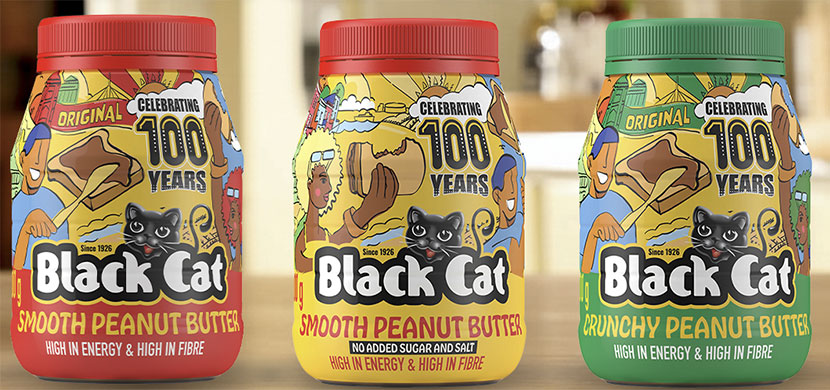
29 May 2026 Black Cat turns 100!
Surely one of the best known and loved, the century‑old peanut butter brand remains one of SA’s most enduring examples of local sourcing, local manufacturing, and long‑term brand equity…..
Tiger Brands’ Black Cat Peanut Butter, is celebrating its 100th anniversary this year, having been born in 1926, under the name Alderton Limited in Potgietersrus, now Mokopane in Limpopo province.
This makes it a little bit younger than its parent company, which was founded by Jacob Frankel in Johannesburg in 1921 as Tiger Oats.
Black Cat was one of the first acquisitions for what would become Tiger Brands around 1940, after immense success producing breakfast oatmeal. Thus, the ultimate snack and sandwich buddy, Black Cat, was born!
By the 1950s, the brand was a major advertiser on Springbok Radio. In the 1960s, it received a massive boost when it signed golfing legend Gary Player as an ambassador.
Today, Black Cat and Koo are comfortably alongside Jungle Oats as Tiger’s mainstay brands, and which has begun to shine again on the JSE.
What sets Black Cat apart in today’s globalised supply chains is its fully local footprint. The peanuts are sourced from long‑established growers in the North West Province.
Cultivation is between October and December, after which the nuts are harvested, sorted, and transported to Tiger’s Gauteng facilities for processing. Here the peanuts undergo strict quality checks, cleaning, roasting, and fine grinding before becoming the finished product that lands on retail shelves nationwide.
Tiger’s Chamdor plant alone can process more than 8,000 tonnes of nuts a year — equivalent to 92 tonnes of peanut butter every day — underscoring the scale behind this household staple.
Tiger Brands rebounds under new CEO
Tiger Brands’ recent performance turnaround provides important context for Black Cat’s milestone.
After years of strategic missteps — including an overextended push into Africa and the costly Dangote Flour Mills acquisition, sold for just $1 after a R1.6-billion investment — the group has spent the past few years refocusing on core categories and operational discipline.
The company had also faced intense pressure at home, from rising competition in bakeries to the reputational fallout of the 2017 listeria outbreak. Between 2017 and 2023, six of its 12 operating segments posted double‑digit profit declines, with bakery profits falling by two‑thirds and grocery profits nearly halving.

Since CEO Tjaart Kruger’s appointment, Tiger has simplified its management structure, removed layers of bureaucracy, and shifted to a federated model that brings executives closer to plant operations.
A renewed focus on equipment maintenance, plant upgrades, and efficiency improvements has helped restore momentum in its core food businesses.
Tiger Brands has also been pruning its portfolio, concentrating investment behind categories where it can win and exiting those where global competitors dominate. Personal care brands have struggled against multinationals such as L’Oréal and Procter & Gamble, while Beacon’s chocolate business has battled to remain profitable against Nestlé and Cadbury.
Source: BusinessTech.co.za