


23 May 2026 Weight-loss pills make more big news
Another week, and yet more GLP‑1 breakthrough stories – 2026 is shaping up to be a pivotal year for these remarkable drugs…..
Remember the name retatrutide. It’s Eli Lilly’s latest experimental GLP-1, and patients who took it lost the most weight ever recorded in a medication trial, according to results just announced.
The study isn’t yet peer-reviewed, but it appears to show retatrutide leaving other GLP-1s in the dust. A “triple agonist” injectable which activates three receptors involved in weight control, it has been dubbed the “Godzilla” of weight-loss medicines. :
- The highest dose made patients lose an average of 28% of their body mass after 80 weeks, running nearly a full lap around the highest dose of Novo Nordisk’s Wegovy (~15% weight loss after 68 weeks).
- The lowest dose of retatrutide still delivered 19% weight loss, making it nearly as effective as the highest dose of Lilly’s Zepbound.
The first GLP-1 that could rival surgery: The trial’s heaviest patients lost an average of 30% of their body weight (or 38,5kg) after two years on retatrutide. That’s about on par with weight loss from gastric bypass surgery.
But… Lilly said 11% of participants on the highest retatrutide dose quit the study because of gastrointestinal side effects — a bigger dropout rate than for less powerful obesity drugs.
Some participants in other research have said they stopped taking retatrutide because they felt they were losing too much weight.
Looking ahead…hot off a major earnings beat and regulatory approval for its new weight loss pill, Lilly expects to file for the FDA’s greenlight on retatrutide as early as this year.
Wegovy pill gets EU nod
The EU’s pharmaceutical regulator has approved Novo Nordisk’s weight-loss pill, Wegovy, for sale.
The recommendation paves the way for it to become the first oral weight-loss treatment available in the bloc, which puts the Danish drugmaker ahead of its American rival, Eli Lilly.
Novo launched the pill in America in December after winning approval from American regulators — four months before Lilly did.
Eli Lilly’s GLP-1 pill, Foundayo (orforglipron), is a once-daily, non-peptide oral medication approved by the FDA for the treatment of type 2 diabetes and chronic weight management. It sets itself apart by not requiring strict morning fasting or water restrictions before consumption.
The global appetite for GLP‑1 weight‑loss drugs is exploding
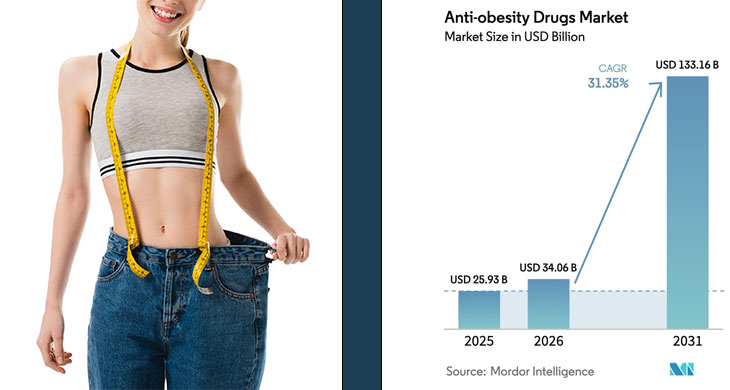
It’s expected that 2026 will bring an even bigger surge of innovation. Spending on GLP‑1s hit $54bn in 2024 and is set to climb sharply as pharmaceutical companies race to expand their offerings
These medicines, best known under brands like Wegovy, Ozempic, Mounjaro and Zepbound, have already proven they do far more than trim waistlines: they also reduce risks across heart, liver and kidney disease, making them one of the most consequential drug classes of the decade.
As oral GLP‑1s arrive, convenience becomes the new battleground. Pills are less potent than injections (which achieve 16–23% weight loss), but their convenience could dramatically expand uptake — though adherence may be lower outside clinical trials, where daily dosing increases the chance of missed pills.
Next‑generation injectables push weight loss even further
The injectable category is also evolving fast, as above with Lilly’s retatrutide, while Novo Nordisk’s CagriSema — combining semaglutide with an amylin analogue — delivered 23% weight loss in phase‑three trials
Meanwhile, companies are developing monthly GLP‑1 injections, including Amgen’s MariTide, which early data suggest may achieve 20% weight loss after a year, pending phase‑three confirmation.
A growing concern is the loss of lean muscle associated with GLP‑1 use. Lilly is testing bimagrumab, an antibody that increases skeletal muscle mass. When combined with semaglutide, it produced 22% weight loss, with an unusually high 93% of that loss coming from fat rather than muscle — a major improvement over semaglutide alone.
Competition, generics and global access
As more products enter the market, competition is expected to push prices down. Some health systems may negotiate population‑scale deals to broaden access.
And when semaglutide’s patent expires in many markets in 2026, generics will open the door to cheaper treatment in countries like Brazil, China and India. One model suggests global access to generic semaglutide could save 2.1–3.1 million lives annually among people with obesity and diabetes.
GLP‑1s continue to surprise researchers. Evidence shows they reduce cardiovascular events, improve sleep apnoea, protect kidneys and liver, and may even reduce addictive behaviours. Early data hint at potential reductions in cancer and Alzheimer’s risk, with more results expected soon.